 Skip to main content
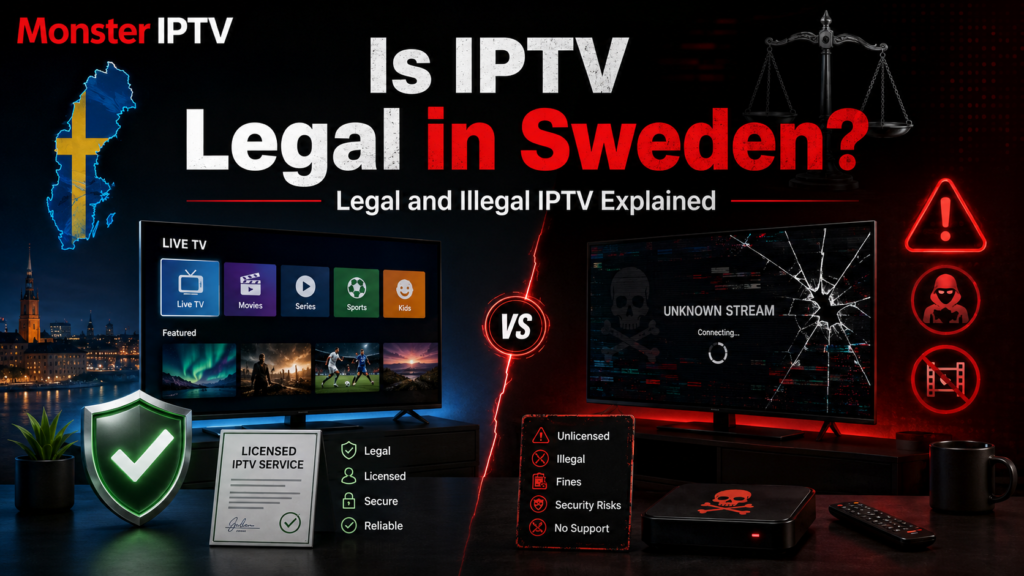
Is IPTV legal in Sweden? Yes, IPTV technology itself is legal. The important question is whether the provider has permission to distribute the TV channels, sports, films, series, and other copyrighted content it supplies.
A licensed internet TV service can operate legally in Sweden. An IPTV service that redistributes copyrighted content without authorization can infringe copyright law.
The rules around individual viewers deserve more explanation. Sweden considered new legislation that would make private use of common illegal IPTV services explicitly punishable, but that proposed change did not take effect on 1 July 2026. In June 2026, the Swedish government instead stated that further analysis and investigation were required before additional measures against illegal IPTV were introduced.
What Makes IPTV Legal or Illegal?
IPTV stands for Internet Protocol Television. It describes a method of delivering television through IP networks rather than defining where the content came from or whether somebody has permission to distribute it.
This means the technology can be used for both authorized and unauthorized services.
A legal IPTV service has the necessary rights or permissions for the content it makes available. Illegal IPTV generally involves television channels or copyrighted programmes being redistributed without permission from the relevant rights holders.
Sweden’s Patent and Registration Office, PRV, explains that illegal streaming services make protected content available without authorization from the people or organizations that hold the rights.
The device does not determine legality either. IPTV can be watched through a Smart TV, Android device, Apple TV, Firestick, computer, IPTV box, or another compatible player. Using one of these devices is not in itself unlawful.
Is IPTV Illegal in Sweden for the Viewer?
This is where simple answers can become misleading.
Swedish authorities already have rules dealing with copyright infringement and unauthorized distribution. However, the government has also been considering whether the law should be clearer and more directly applicable to private consumers of modern illegal IPTV services.
In September 2025, the Swedish government inquiry SOU 2025:100, Åtgärder mot illegal ip-tv, proposed changing the rules so that private use of the type of unauthorized IPTV service common today would be explicitly covered. The inquiry discussed the limitations of older rules that were designed around technologies where decoding happened at the customer’s equipment. Modern illegal IPTV commonly works differently because content can be decoded centrally and then streamed to subscribers.
The proposal was initially discussed with a possible implementation date of 1 July 2026. That change was not introduced by that date.
In June 2026, the government said that further work was needed on measures to prevent illegal IPTV distribution and strengthen legislation against those providing such services. It also indicated that questions such as expanded blocking measures would continue to be investigated.
So, as of August 2026, it would be inaccurate to say that Sweden introduced the proposed new blanket user offence on 1 July 2026.
It would also be inaccurate to conclude that watching clearly unauthorized streams is therefore automatically lawful or risk-free.

EU Copyright Law Also Matters
Sweden is an EU member state, so European copyright law and decisions from the Court of Justice of the European Union are relevant.
In the Filmspeler case, C-527/15, the EU Court considered temporary copies created while streaming copyrighted material from websites offering it without permission. The Court ruled that those temporary reproduction acts did not qualify for the normal exemption where the circumstances involved unauthorized sources.
That ruling is one reason the legal position cannot be reduced to “streaming is always legal because nothing is downloaded.”
Streaming can still involve temporary technical copies.
PRV also explains more generally that copyright infringement can lead to consequences such as injunctions, compensation, damages, seizure, or criminal sanctions depending on the circumstances, including questions of intent and negligence.
For individual legal advice concerning a specific service or situation, a qualified Swedish lawyer is more appropriate than a general IPTV guide.
How Does Illegal IPTV Work?
Illegal IPTV usually involves acquiring television or video content and redistributing it without the necessary authorization from broadcasters, studios, sports rights holders, or other copyright owners.
The operation may involve several levels:
- content being captured or obtained without redistribution rights
- servers or infrastructure distributing streams over the internet
- resellers selling accounts or subscriptions
- customers accessing the streams through IPTV players or boxes
The IPTV app itself may be completely legitimate. Applications that support M3U playlists, EPG data, or other internet streams can be used for authorized content as well as unauthorized content.
The same applies to an IPTV box or Smart TV. Hardware does not make a subscription legal or illegal.
PRV categorizes illegal streaming as a form of online piracy and notes that unauthorized services can generate income through subscriptions, advertising, donations, or related activities.
How Can You Tell Whether an IPTV Service Is Legal?
There is no single technical test that proves a provider has the required content licences.
A professional website, functioning IPTV player, Swedish channels, an EPG, HD streams, or a paid subscription do not prove that redistribution rights exist.
When evaluating a service, look for transparency about:
- the company or organization operating the service
- which content it is authorized to provide
- licensing or distribution rights
- clear terms and conditions
- legitimate customer and company information
- where premium channels and sports rights come from
Be cautious when a provider appears to offer large amounts of premium content from unrelated broadcasters without explaining how it has obtained those rights.
Price alone is not proof either. An inexpensive service is not automatically illegal, and a more expensive service is not automatically legitimate.
PRV provides information designed to help Swedish consumers identify and find lawful streaming alternatives.
If you are comparing IPTV features rather than legal status, the Monster IPTV FAQ contains general information about the service and technical use. Licensing should still be assessed separately.
Is Free IPTV Illegal?
Not automatically.
There are legitimate television streams that are available without a paid subscription. Broadcasters, public organizations, and content owners may choose to make certain streams publicly accessible.
The relevant question is permission.
A free stream that is published with the rights holder’s authorization can be lawful. A free M3U playlist that retransmits paid sports, premium channels, films, or series without permission may not be.
The fact that an IPTV playlist is publicly accessible online does not prove that the person publishing it owns redistribution rights.
Can a VPN Make Illegal IPTV Legal?
No.
A VPN changes how internet traffic travels between your device and the internet. It can affect your visible IP address and provide an encrypted connection between your device and the VPN server.
It does not provide copyright licences.
If a provider does not have permission to distribute particular content, connecting through a VPN does not create that permission.
The same principle applies to changing DNS settings, using a different IPTV player, or watching through another device.
What Is Sweden Doing About Illegal IPTV in 2026?
Swedish policy in this area is still developing.
The 2025 government inquiry proposed several measures, including clearer rules around private consumption, stronger enforcement, and further investigation of live blocking.
After consultation on the proposals, the government announced in June 2026 that more analysis was needed. Its current position includes further investigation of ways to stop distribution and strengthen measures against providers of illegal IPTV.
Swedish courts can already issue certain blocking injunctions against internet services used to distribute unauthorized IPTV. The government has identified problems with the time required for those processes, particularly when dealing with live events such as sports.
Anyone publishing information about Swedish IPTV law should therefore check for updates regularly because the regulatory position may continue to change.
You can find additional technical information separately in the Monster IPTV installation guides, which cover IPTV setup rather than determining whether a particular content source has distribution rights.
FAQ
Is IPTV legal in Sweden?
Yes. IPTV technology is legal in Sweden. Legality depends primarily on whether the service has authorization to distribute the content it provides.
Is illegal IPTV the same as IPTV?
No. IPTV is a technology. Illegal IPTV refers to IPTV services distributing copyrighted content without the necessary permission.
Did Sweden make watching illegal IPTV punishable in July 2026?
The 2025 inquiry proposed clearer rules addressing private use, with July 2026 discussed as an implementation date. That proposed change did not take effect then. In June 2026, the government stated that further analysis and investigation were necessary.
Can watching an unauthorized stream still create copyright issues?
Potentially, yes. EU case law has established that temporary copies created when knowingly accessing unauthorized streaming sources do not automatically qualify for the temporary-copy copyright exception.
Does paying for an IPTV subscription mean it is legal?
No. Payment alone proves only that a transaction occurred. It does not prove that the provider has obtained the rights to redistribute the channels or programmes included.
Conclusion
IPTV itself is legal in Sweden, but the source and licensing of the content determine whether an IPTV service is authorized. Sweden has been considering tougher measures against illegal IPTV, although the proposed explicit change for private users did not take effect in July 2026 and further government work is continuing. Before using any IPTV service, verify its content rights rather than assuming that an app, payment, playlist, or professional website proves legality. For general service and IPTV information, you can also visit Monster IPTV.
